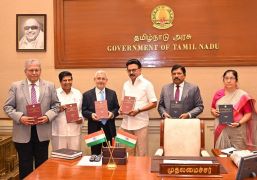
Tamil Nadu government's High-Level
Committee on Union-State Relations submitted the first part of its report in
April 2025
The Tamil Nadu government's High-Level Committee on
Union-State Relations submitted the first part of its report in April 2025,
recommending a "structural restructuring" of Indian federalism. The
committee is chaired by Justice Kurian Joseph (retired Supreme Court judge).
Based on Constituent Assembly debates, academic scholarship, and previous
committees (Sarkaria, Punchhi, NCRWC), the report maps patterns of
centralization and proposes constitutional and institutional reforms. The
report argues that India's federal structure, created as a result of Partition
and the integration of princely states, has become overly centralized, incompatible
with the country's political maturity and diversity. It presents eleven
fundamental arguments for decentralization, including the freedom argument, the
democracy argument, and the innovation argument; it also critiques the
"fallacy of uniformity" and the "fallacy of control."
Key Recommendations of the Committee
¨
Constitutional Amendments
and Basic Structure: Article 368 should be amended to require ratification by
two-thirds of the states, representing two-thirds of the total population, for
most constitutional amendments, thereby strengthening federal consensus. An
explicit "basic features" clause should be added to Article 368,
listing immutable features such as federalism, democracy, secularism, judicial
review, and free elections, thus codifying the basic structure doctrine.
¨ Territorial Integrity of
States and Union Territories (UTs): Parliament's unilateral power under Article
3 should be curtailed by requiring consent from a "special majority"
of the affected state, and in some cases, a "referendum," before
altering the boundaries or status of a state. A new Article 3A should be added
to prohibit the creation of new Union Territories and provide for periodic
referendums on the future status of existing Union Territories.
¨
Language Policy: Support
for pluralistic federalism, rejecting the “one nation, one language” approach.
Article 343 should be amended to make English the permanent official language
of the Union and references to Hindi should be removed from Article 345. A
“National Language Commission” should be established in place of the “Special
Officer for Linguistic Minorities,” and the “three-language formula” should be
replaced with high-proficiency bilingualism (English + mother tongue/state
language).
¨ Role of Governors:
Article 155 should be amended to mandate the President to appoint one of three
nominees approved by the State Legislature. Article 156 should be amended to
abolish the principle of continuance and fix the Governor's term for a single,
non-renewable term of five years, allowing their removal only through a
resolution of the State Legislature. A new “Thirteenth Schedule” should be
included containing instructions clearly limiting the Governor's discretion.
¨ Fiscal federalism and
GST: The voting weights should be reviewed to increase state representation,
and in line with the Mohit Minerals (2022) decision, it should be clarified
that its decisions are only recommendatory. Ensure predictable and rule-based
transfers to states.
¨ Representation and delimitation: The moratorium on inter-state Lok Sabha seat allocation should be extended until 2126 or until inter-state fertility rates are equalized, to protect the representation of states that have achieved population control.
¨ Legislative and administrative powers: The electoral administration of the center and states should be separated, empowering state election commissions, and reducing central interference in electoral processes. Education should be reinstated in the State List, restoring state control over medical education, and restructuring centrally sponsored schemes (CSS) in the health sector.
.jpg)