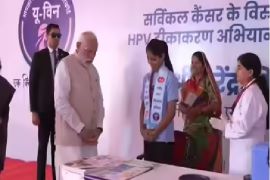
Nationwide HPV Vaccination Program for
14-Year-Old Girls: A Major Step Toward Cervical Cancer Prevention
The Government of India has announced a significant
initiative prioritizing women's health. A nationwide Human Papillomavirus (HPV)
vaccination program will soon be launched for 14-year-old girls to prevent
cervical cancer. This program will be voluntary and completely free for all
socioeconomic classes.
What is HPV and its risks?
¨
Human papillomavirus
(HPV) is a common virus that is primarily transmitted through sexual contact.
Some types of it cause cervical cancer. This cancer is one of the most common
cancers in women in India.
More on the News
¨
The campaign will provide
free and voluntary vaccination to 14-year-old girls at designated government
health facilities across India.
¨
Each year, the programme
will target girls turning 14, covering an estimated 1.2 crore adolescents
annually.
¨
Cervical cancer remains
the second most common cancer among Indian women, with nearly 80,000 new cases
and over 42,000 deaths reported every year.
¨
Persistent infection with
high-risk HPV strains, particularly types 16 and 18, causes over 80% of
cervical cancer cases in India.
¨
The initiative follows
sustained advocacy for cervical cancer prevention, including emphasis by PM
Narendra Modi during the Quad Cancer Moonshot in September 2024.
¨
The programme aligns with
global best practices and expert recommendations, including those of the
National Technical Advisory Group on Immunisation.
Human Papillomavirus (HPV) Vaccination
Programme
¨
Vaccine to Be Used: India
will use Gardasil, a quadrivalent HPV vaccine, that shows adequate protection
against genital warts.It protects against HPV types 16 and 18 (major causes of
cervical cancer) and types 6 and 11.India has adopted a single-dose strategy,
supported by global and Indian scientific evidence showing strong and durable
protection.
¨
Procurement and Global
Support: Vaccine supplies have been secured through a transparent, globally
supported mechanism.Under partnership with Gavi, the Vaccine Alliance, 2.6
crore doses have been committed, with around 1.5 crore doses already
delivered.Approximately 1.2 crore doses will be required annually.
¨
Procurement follows
stringent quality and cold chain standards.
¨
Implementation Strategy:
The drive will be conducted as a special campaign, separate from the Universal
Immunisation Programme.Vaccination will be available at government facilities
such as Ayushman Arogya Mandirs (Primary Health Centres), Community Health
Centres, Sub-District and District Hospitals and Government Medical
Colleges.Beneficiaries will be tracked through the U-WIN digital platform for
efficient monitoring and record-keeping.Sessions will be supervised by trained
medical officers and linked to 24×7 government health facilities for managing
rare adverse events.
Significance of the Vaccine
¨
Prevention of Cervical
Cancer: Prevents infection from HPV types responsible for the majority of
cervical cancer cases and directly reduces future cancer incidence and
mortality.
¨
High Effectiveness and
Safety: Demonstrates 93–100% effectiveness against vaccine-covered HPV types,
is a non-live vaccine that does not cause HPV infection, and has over 500
million doses administered globally since 2006, reinforcing safety and
efficacy.
¨
Reducing Healthcare
Burden: Lowers long-term treatment costs and pressure on oncology services
while protecting lakhs of girls from a largely preventable disease.
¨
Equity and Accessibility:
Free-of-cost vaccination ensures inclusion across socio-economic groups, and
nationwide implementation ensures uniform access across States and Union
Territories.
¨
Alignment with Global
Goals: Supports global efforts to eliminate cervical cancer as a public health
problem, and adoption of a single-dose schedule improves coverage,
affordability, and scalability.
Cervical Cancer
¨
Cancer developing in the
cervix of a woman is called cervical cancer. It generally develops and
progresses over time, characterized by the early appearance of cancer cells in
the cervical tissue, which extend widely and more deeply further into the
cervix and other adjacent areas. Cervical cancer is mainly caused by
long-lasting infection with high-risk types of viruses. The two most common
high-risk types are human papillomavirus (HPV-16) and HPV-18, which cause 70%
of cases worldwide.
¨
Risk Factors: Women
living with HIV are six times more likely to develop cervical cancer, and about
5% of cases are attributable to HIV.Other risk factors include immune status,
oncogenic HPV type, multiple births, early pregnancy, hormonal contraceptive
use, smoking, other STIs, and broader determinants like gender inequality and
poverty.
¨ Status: It is the fourth most common type of cancer among women globally and one of the leading causes of cancer-related deaths among women worldwide.Cervical cancer is the third most common cancer in India. States such as Mizoram, Arunachal Pradesh, Karnataka, and Nagaland report a significant burden, with disability-adjusted life years (DALYs) exceeding 300 per 100,000 women. By 2025, India’s overall cervical cancer burden is projected to reach approximately 1.5 million DALYs.
¨ Types of HPV vaccines available in India: Cervarix (bivalent), Gardasil (quadrivalent), including Gardasil 9 (nonavalent), and Cervavac are the main HPV vaccines available in India.

.jpg)