India and Gulf Cooperation Council Sign
Terms of Reference for India–GCC Free Trade Agreement
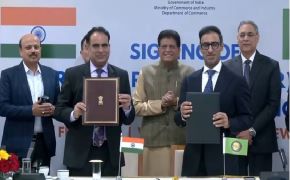
India and the Gulf Cooperation Council have signed the
Terms of Reference in New Delhi, formally launching negotiations for a Free
Trade Agreement between India and the six-nation Gulf bloc.Framework for
Negotiations: The ToR defines the scope, objectives, and modalities of the
proposed FTA, covering trade in goods, services, and investment.Scale of
Economic Engagement: India–GCC goods trade stood at USD 178.56 billion in FY
2024–25 (Exports: USD 56.87 bn; Imports: USD 121.68 bn), accounting for 15.42%
of India’s global trade.Sectoral Coverage: Key sectors expected to benefit
include food processing, infrastructure, petrochemicals, textiles, gems and
jewellery, machinery, and ICT.Investment Linkages: The GCC is a major source of
capital, with cumulative FDI inflows into India exceeding USD 31.14
billion.Institutional Continuity: India already has trade agreements with UAE
and Oman and is in negotiations with Qatar, indicating growing economic
integration with the region.
Significance
¨
Energy and Food Security:
The FTA is expected to enhance the stability and diversification of India’s
energy supplies from a region that is a major source of crude oil, natural gas,
and petrochemicals, while positioning India as a reliable food supplier to the
GCC.
¨
Geopolitical and
Strategic Value: The agreement strengthens India’s engagement with a
strategically vital region amid global economic uncertainty, reinforcing
predictability and long-term partnership.
¨
Diaspora and Services
Linkages: With nearly 10 million Indians living and working in GCC countries,
the FTA can deepen services trade, remittances, and people-to-people ties.
¨ Growth and Employment: By
improving market access and investment flows, the agreement is expected to
boost manufacturing, infrastructure development, and job creation in both India
and the GCC.
Gulf Cooperation Council (GCC)
¨
The Gulf Cooperation
Council (GCC), formally known as the Cooperation Council for the Arab States of
the Gulf, is a political and economic alliance of six Middle Eastern countries:
Saudi Arabia, the United Arab Emirates, Qatar, Kuwait, Oman, and Bahrain.
¨
It was established in May
1981 in Riyadh, Saudi Arabia, to promote unity and cooperation rooted in shared
Arab and Islamic cultural identity.
Objectives
¨
As per Article 4 of the
GCC Charter, the Council seeks to strengthen relations among member states and
promote cooperation among their citizens across political, economic, security,
and social domains.
¨
The presidency of the GCC
rotates annually among member states.
¨ The bloc is a global
energy giant, controlling approximately 30% of the world’s oil reserves and a
significant portion of its natural gas. It has a combined GDP of over $2.25
trillion.
¨
It is governed by three
main bodies: the Supreme Council (heads of state), the Ministerial Council
(foreign ministers), and the Secretariat General (the administrative arm).
Some of the key Free trade agreements of
India
¨
India–European Union (EU)
FTA: Signed in January 2026 after nearly 20 years of talks, this deal
eliminates tariffs on over 90% of goods and covers roughly 99.5% of India’s
export value to the EU.
¨ India–Oman CEPA: Formally
signed on December 18, 2025, this Comprehensive Economic Partnership Agreement
(CEPA) grants duty-free access to 99.38% of Indian exports and is set for
implementation in early 2026.
¨
India-UK FTA negotiations
were launched in January 2022.
¨ The India-Australia Comprehensive Economic Cooperation Agreement (CECA) builds on the foundation laid by the India-Australia Economic Cooperation and Trade Agreement (ECTA), which came into force in December 2022.
¨ India-UAE Comprehensive Partnership Agreement (CEPA): It is in effect from May 2022.
.jpg)