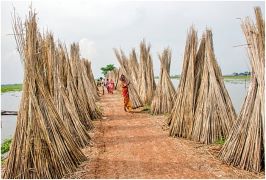
Increase in MSP for raw jute: Boost to
farmers' income and green economy
Cabinet Committee on Economic Affairs (CCEA)'s
decision to increase the Minimum Support Price (MSP) for raw jute for the
2026-27 marketing season is being considered a significant step in the interest
of farmers. This decision will not only ensure better income for jute producers
but will also strengthen the natural fiber-based industry in the country.
Objective of the Decision
¨
The government's primary
objective in increasing the MSP is to ensure jute farmers receive a fair price
for their produce. Jute is primarily grown in states such as West Bengal,
Assam, Bihar, Odisha, and Meghalaya, where a large number of farmers depend on
it. The increase in MSP will provide these farmers protection from market price
volatility.
More on the News
¨
The MSP of Raw Jute of
TD-3 grade has been fixed at ₹5,925 per quintal for the 2026–27 season.
¨
TD-3 (Tossa Desi) is a
specific quality grade defined by the Jute Corporation of India (JCI) based on
several physical attributes.
¨
The revised MSP is ₹275
per quintal (or 4.9%) higher than the MSP for the 2025–26 marketing season
(₹5650 per quintal).
¨
The MSP ensures a return
of 61.8% over the all-India weighted average cost of production.
¨
The decision is in line
with the principle announced in the Union Budget 2018–19 to fix MSP at a
minimum of 1.5 times the all-India weighted average cost of production (A2+FL).
¨
Over the years, the
government has increased the MSP of Raw jute from ₹2400/-per quintal in 2014-15
to ₹5,925/- per quintal in 2026-27, registering an increase of ₹3,525/- per
quintal (2.5 times).
¨
The Jute Corporation of
India (JCI) works as the central government’s nodal agency to undertake Price
Support Operations.
MSP Regime of India
¨
MSP introduced in 1966-67
is a price fixed by the Government of India to protect the agricultural
producers against any sharp fall in farm prices.
¨
MSPs are announced by the
Cabinet Committee on Economic Affairs (CCEA) at the beginning of the sowing
season for certain crops (currently 23) based on the recommendations of the
Commission for Agricultural Costs and Prices (CACP).
¨
The Government announces
MSP for 22 mandated crops and fair and remunerative price (FRP) for sugarcane.
The list of crops is as follows:
¨
Cereals (7) – paddy,
wheat, maize, jowar (sorghum), bajra (pearl millet), barley and ragiPulses (5)
– gram, tur, moong, urad, masur (lentil)
¨
Oilseeds (7) – groundnut,
rapeseed-mustard (+ toria), soyabean, sesamum, sunflower, safflower, nigerseedCommercial
crops (4) – copra (+ de-husked coconut), sugarcane, cotton and raw jute.
In formulating the recommendations for minimum support
prices, the CACP takes into account various factors such as – cost of
production (A2+FL method), demand and supply conditions, inter-crop price
parity, effect on general price level, domestic and international prices, etc.
National Commission on Farmers:
Swaminathan Committee
¨
It recommended that MSPs
must be at least 50% more than the cost of production (C2).
¨
It suggested the cost of
production at three levels:
¨
A2: All the types of cash
expenditure to generate the crop, like seeds, manure, chemicals, labour costs,
fuel costs and irrigation costs.
¨
A2+FL: It includes A2
plus an imputed value of unpaid family labour.
¨
C2: Under C2, the
estimated land rent and the cost of interest on the money taken for farming are
added to A2 and FL.
¨
Presently, CACP uses the
A2+FL method for calculating the cost of production.
Jute Crop & Jute Industry of India
¨
climates and requires
about 50 cm of water for its growth.
¨
For better growth, a mean
temperature between 15oC and 34oC is best suitable for the crop, and a mean
relative humidity of 65% is required for Jute, also known as golden fibre, is a
crop that grows well in humid tropical better growth.
¨
It can be raised on all
kinds of soils from clay to sandy loam, but loamy alluvials are best suited.
¨
It is a cash crop, and it
is sown from March to May and harvested from the end of June to September
depending on the weather conditions.
¨
It is the second most
important fibre crop in India after cotton in terms of cultivation and usage.
¨
India is the largest
producer of Jute in the World, accounting for about 50% of the estimated world
production. However, most of the Jute (about 90% of total production) is
consumed domestically due to its vast domestic market demand.
¨ The major jute-producing states in India are West Bengal (the largest jute-producing state), Assam, Bihar, Odisha, and Andhra Pradesh.
¨ India exports jute and jute products mainly to the USA, the UK, Australia, Belgium, Egypt, Germany, Italy, Japan, Saudi Arabia, and Turkey.