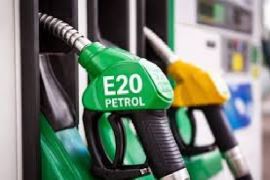
E20 petrol mandatory nationwide from April
1, 2026: Indian government's major decision
In a significant move, the Indian government has
announced that the sale of 20% ethanol-blended petrol (E20) with a minimum
research octane number (RON) of 95 will be mandatory across the country from
April 1, 2026. This decision will apply equally to all states and union
territories.
What is E20 petrol?
¨
E20 petrol is a fuel that
contains a blend of 20% ethanol and 80% petrol. Ethanol is a biofuel primarily
produced from sugarcane, corn, and other agricultural products. It is
considered more environmentally friendly than conventional petrol.
Main point
¨
The directive was issued
by the Ministry of Petroleum and Natural Gas, requiring oil companies to supply
ethanol-blended petrol that meets Bureau of Indian Standards (BIS)
specifications.
¨
The order allows limited
exemptions in special situations for specific regions and for a defined period.
¨
The move is part of
India’s broader strategy to reduce crude oil imports, lower emissions, and
promote domestically produced renewable fuels.
About the Ethanol
¨
Ethanol is an anhydrous
ethyl alcohol with the chemical formula C₂H₅OH.
¨
It can be produced from
sugarcane, maize, wheat, and other high-starch crops.
¨
In India, ethanol is
primarily produced from sugarcane molasses through fermentation.
¨
Ethanol can be blended
with gasoline to form various ethanol-gasoline blends.
¨
Its oxygen content allows
engines to combust fuel more completely, reducing emissions and environmental
pollution.
¨
As ethanol is produced
from plants that harness solar energy, it is considered a renewable fuel.
Ethanol Blending
¨
Ethanol is mixed with
petrol to reduce emissions and partially replace fossil fuels.
¨
E10 contains 10% ethanol,
while E20 contains 20%.
¨
E20, or Ethanol 20, is
petrol blended with 20% ethanol, a biofuel typically derived from sugarcane,
corn, or surplus grain.
¨
The Ethanol Blending
Programme has also helped reduce reliance on imported crude oil.
¨
The EBP was launched in
January 2003 to promote alternative, environmentally friendly fuels and reduce
India’s dependence on imported energy.”
¨
According to the oil
ministry, India has saved more than ₹1.40 lakh crore in foreign exchange since
2014–15 through petrol substitution.
¨
India achieved 10%
ethanol blending in petrol in June 2022, ahead of schedule, and subsequently
advanced its 20% blending target from 2030 to 2025–26. Many fuel stations already sell E20 in
several parts of the country.
¨
India has committed to
reducing its GDP emissions intensity by 45% by 2030 (from 2005 levels) and
achieving net-zero emissions by 2070, as part of its Panchamrit strategy
announced at COP26.
Research Octane Number (RON)
¨
It is a measure of a
fuel’s resistance to engine knocking or pre-ignition, a condition where fuel
burns unevenly inside the engine cylinder.
¨
Knocking can cause a
pinging sound, reduced efficiency, power loss, and long-term engine damage.
¨
Higher RON fuels are more
stable under high compression and temperature, making them suitable for modern
high-performance engines.
¨
Role of Ethanol in Octane
Rating: Ethanol naturally has a high-octane rating of around 108 RON. When
blended with petrol, it increases the overall octane level of the fuel, improving
combustion stability and reducing knocking.
Significance of the RON 95 Requirement
¨
Engine Protection:
Ensures compatibility with modern engines and prevents knocking-related damage.
¨
Performance Stability:
Maintains smooth combustion and consistent engine performance, especially under
high compression conditions.
¨ Support for E20 Transition: As ethanol content increases, ensuring adequate octane levels helps avoid efficiency losses and mechanical stress.
¨ Future-Ready Fuel Ecosystem: Higher-octane fuel aligns with evolving automotive technologies, including turbocharged and high-compression engines.


 Extended.jpg)