Cabinet Approves Two New Semiconductor
Projects Under India Semiconductor Mission
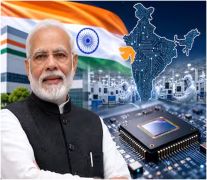
Union Cabinet has approved two new semiconductor
projects under the India Semiconductor Mission (ISM), marking a significant
step towards strengthening India’s semiconductor and electronics manufacturing
ecosystem. The approved projects include India’s first commercial
Mini/Micro-LED display manufacturing unit based on Gallium Nitride (GaN)
technology and a semiconductor packaging unit to be established in Gujarat.
About the Projects
¨
Crystal
Matrix Limited (CML) Project: Crystal Matrix Limited
will establish an integrated facility for compound semiconductor fabrication
and ATMP (Assembly, Testing, Marking and Packaging) at Dholera, Gujarat. The
project involves a cumulative investment of about ₹3,068 crore. The facility
will manufacture Mini/Micro-LED display modules based on Gallium Nitride (GaN)
technology and provide GaN foundry services, including epitaxy on 6-inch
wafers. The facility will produce 72,000 sq. metres of Mini/Micro-LED display
panels annually and 24,000 sets of RGB GaN epitaxy wafers annually. The
products will be used in large displays for TVs and commercial signage,
medium-sized displays for tablets, smartphones, and in-car systems, and
micro-displays for XR glasses and smartwatches.
¨
Suchi
Semicon Private Limited (SSPL) Project:
Suchi Semicon Private Limited will establish an Outsourced Semiconductor
Assembly and Test (OSAT) facility in Surat, Gujarat. The project involves an
investment of around ₹868 crore. The facility will manufacture discrete
semiconductors and focus on lead frame and wirebond packaging technologies. The
facility will have a total production capacity of 1,033.20 million chips per
annum, including 673 million SOIC (Small Outline Integrated Circuit) units and
263 million Transistor Outline (TO) units annually. The semiconductors will be
used in power electronics, Analog Integrated Circuits (ICs), industrial
systems, automotive electronics, industrial automation, consumer electronics,
EV battery management systems and solar inverters. The two projects together
are expected to generate employment for around 2,230 skilled professionals,
while the SSPL project alone is expected to create around 630 direct jobs.
Significance of the Projects
¨
Strengthening
India’s Semiconductor Ecosystem: With these
approvals, the total number of projects approved under ISM has increased to 12
projects with cumulative investments of around ₹1.64 lakh crore, strengthening
India’s semiconductor manufacturing capabilities across fabrication, packaging
and display technologies.
¨
India’s
First Commercial Display Facility: The CML project
marks the establishment of India’s first commercial Mini/Micro-LED display
manufacturing facility, reducing dependence on imports in advanced display
technologies.
¨
Boost to
Emerging Technologies: The projects will
support future technologies such as Extended Reality (XR), smart wearables,
automotive electronics, industrial automation and Artificial
Intelligence-enabled devices.
¨
Supply
Chain Resilience and Strategic Importance:
Semiconductor manufacturing is critical for national security, digital
infrastructure, and industrial competitiveness, and the projects align with the
vision of Aatmanirbhar Bharat and “Make in India, Make for the World.”
¨
Expanding
Design and Manufacturing Base:
India’s growing semiconductor ecosystem is being supported through design
infrastructure assistance to 315 academic institutions and 104 start-ups, while
two approved semiconductor projects have already started commercial shipments
and two more are expected to begin shipments soon.
India Semiconductor Mission (ISM)
¨
The India Semiconductor
Mission (ISM) was launched in 2021 with an outlay of ₹76,000 crore.
It aims to build a full-stack
semiconductor ecosystem in India covering
¨
Compound semiconductors.
¨
Semiconductor packaging
and testing.
¨
Display manufacturing.
¨
Semiconductor fabrication
(fabs).
¨ Chip design and innovation.
The scheme provides up to 50% fiscal support for eligible semiconductor and display manufacturing projects.

.jpg)