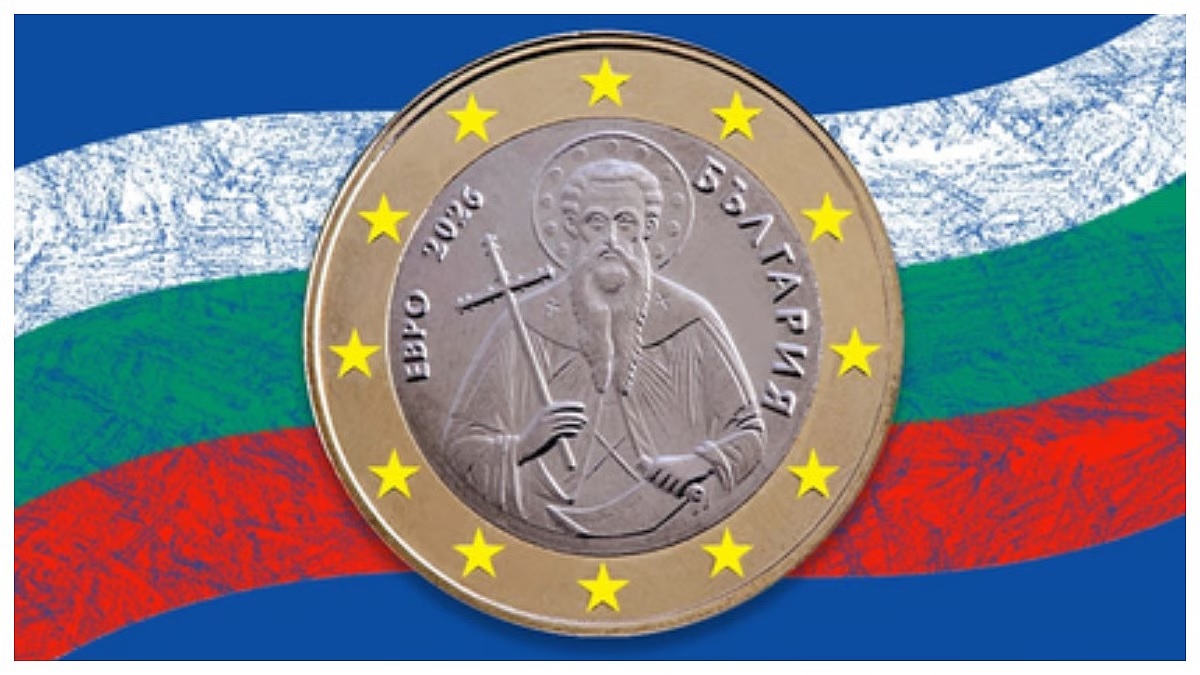
Bulgaria officially adopted the euro, becoming the
21st member of the Eurozone, nearly 20 years after joining the European Union,
a move with major economic, political, and geopolitical implications.Bulgaria
gave up the lev, in circulation since the late 19th century, marking a full
transition to the euro.Rationale: Euro adoption aims to boost trade, improve
market transparency, and attract investment in Bulgaria (EU’s poorest member
state).It will deepen Bulgaria’s integration with the European Union,
reinforcing its Western alignment and reducing Russian economic
influence.Eurozone: The Maastricht Treaty (1992) (also known as the Treaty on
European Union) laid the foundation for the European Union by paving the way
for a common Economic and Monetary Union, the adoption of the euro as a single legal
tender, the creation of a unified central banking system through the European
Central Bank (ECB), and the establishment of a common economic region
(Eurozone).The Eurozone comprises European Union Member States that have
adopted the euro as their common currency. The eurozone was established with
the official launch of the euro on 1st January 1999, in 11 countries. With Croatia joining in 2023 and Bulgaria’s
adoption, the euro is now used by over 350 million people across Europe.
European Union, Eurozone, and Schengen
Area
|
Aspect |
European Union |
Eurozone |
Schengen Area |
|
About |
A political and economic
union of European countries. |
A monetary union of
EU countries using the euro. |
A European visa free travel
zone, with no internal border checks. |
|
Purpose |
Economic integration, common policies, political
cooperation. |
Common currency and unified monetary policy. |
Free movement of people across borders. |
|
Establishment Treaty/Agreement |
Maastricht Treaty (1992) |
Maastricht Treaty(1992) |
Schengen Agreement (1985) |
|
Number of countries (as of January
2026) |
27 countries. |
21 countries. EU countries Sweden, Poland,
the Czech Republic, Hungary, Romania, and Denmark have not yet
adopted the euro. |
29 countries: 25 EU Member States
(except Ireland, Cyprus) and 4 non-EU countries (Iceland,
Norway, Switzerland and Liechtenstein). |
|
Note: Countries
like Andorra, Monaco, Vatican City, and San Marino use the euro
through agreements with the EU, while Kosovo and Montenegro use it
unilaterally, none of these are regarded as eurozone members. |
|||
Bulgaria
¨
Bulgaria is located in
southeastern Europe on the Balkan Peninsula. It shares land borders with
Romania (north), Serbia and North Macedonia (west), Greece and Türkiye (south),
and has a coastline along the Black Sea (east).
¨
Bulgaria is a member of
North Atlantic Treaty Organization (NATO) and the European Union, with the EU
as its main trading partner, and Sofia serving as its political and economic
capital.
.jpg)